
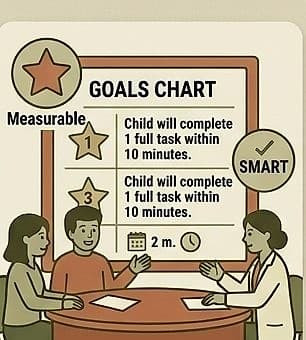
A goal that cannot be measured cannot be tracked, and a goal that cannot be tracked cannot demonstrate progress -- which makes it functionally useless for clinical, family communication, and often insurance/funding purposes alike.
The SMART framework is the most widely used structure for writing measurable clinical goals: Specific (exactly what skill or behavior, under what conditions), Measurable (progress can be observed and quantified, not just inferred from a general impression), Achievable (realistic given the child's current level and typical rate of progress), Relevant (directly connected to the identified concern or diagnosis), and Time-bound (includes a clear timeframe for review) (Mentalyc, "How to Write SMART Goals in Therapy").
Compare a weak goal to a strong one. Weak: "Child will improve social skills." This fails nearly every SMART criterion -- it doesn't specify which social skill, under what conditions, how it will be measured, or by when. Strong: "During structured play sessions with one peer, child will initiate a request to join play (verbally or with an assistive communication device) in at least 3 out of 5 observed opportunities, across two consecutive sessions, within 8 weeks." This version specifies the exact skill, the condition, the measurement method, and the timeframe -- meaning any clinician could pick up this goal cold and know exactly how to score progress, without needing to ask the original author what they meant.
A practical technique for writing measurable goals is to imagine handing the goal to a colleague who has never met the child and asking, "Could you score whether this goal was met just from this sentence, without asking me anything else?" If the answer is no -- if you'd need to clarify what "improve" means, or what counts as success -- the goal needs to be rewritten with more specificity.
It's also worth setting goals at an appropriate grain size: goals that are too broad (an entire domain, like "improve language") are hard to track meaningfully, while goals that are too narrow (a single, highly specific instance) may not capture generalized progress. A well-written goal usually targets a specific skill that, once achieved, demonstrably improves the child's functioning in a meaningful, real-world way -- connecting back to the collaborative, routine-embedded goal-setting principles from Module 4.5.
Practical takeaway: Run every goal you write through the "cold colleague" test -- could someone who has never met the child score progress on this goal using only the words on the page? If not, add specificity until they could.
This guide is general information, not a diagnosis or medical advice. If you're worried about your child, the next step is a conversation with a qualified therapist.
Keep reading
More for your practice
Structured courses with completion tracking live in your therapist dashboard.