
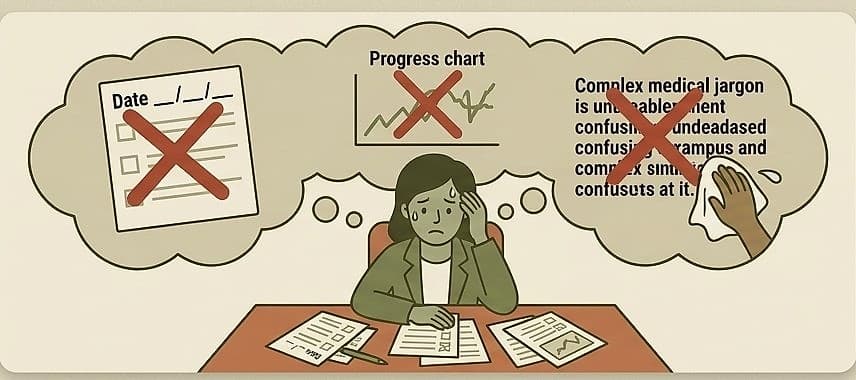
Even well-trained clinicians fall into predictable documentation traps, especially under time pressure. Recognizing these patterns early helps you avoid building them into habit.
Vagueness. Statements like "client seemed better today" or "made some progress" provide no usable information to a future reader. The fix, as covered throughout this module, is to always anchor notes in specific, quantified, observable detail (Mentalyc, "Common Mistakes Therapists Make in Progress Notes"). Incompleteness. Omitting key elements -- what intervention was actually used, how the child responded to it, or any safety-relevant information -- breaks the continuity of care for whoever reads the chart next. A simple mental (or literal) checklist before closing a note -- presentation, intervention, response, plan -- helps catch this.
Inconsistency. Switching note formats, terminology, or abbreviations partway through a case makes it hard to track change over time and can create confusion or even clinical errors when multiple people access the same chart. Standardizing format and terminology, and sticking with it for a given case, keeps the record legible over time. Recording interpretation as if it were observed fact. As covered in Module 5.2, writing "client was anxious" in an Objective section, rather than describing the specific signs observed and placing the interpretation in the Assessment section, is one of the most common and most consequential documentation errors.
Copy-paste redundancy. Reusing a previous note's Assessment section without meaningfully updating it to reflect the current session creates a false record that nothing has changed, which is both clinically misleading and can raise concerns during any external review of the chart. Vague plans. Ending a note with "continue therapy" or "keep working on goals" gives no actionable direction. A strong plan section names the specific next step, the specific strategy to be used or continued, and ideally a specific timeframe for reassessment -- directly applying the SMART principles from Module 5.4 to the Plan section itself, not just to formal treatment goals.
Delayed documentation. Writing notes long after a session, relying on memory, predictably leads to lost detail and can introduce inaccuracies. Writing notes as close to the session as your workflow allows preserves accuracy.
Practical takeaway: Before finalizing any note, scan it specifically for these seven patterns -- vagueness, incompleteness, inconsistency, interpretation-as-fact, copy-paste redundancy, vague plans, and delay -- as a final quality check.
This guide is general information, not a diagnosis or medical advice. If you're worried about your child, the next step is a conversation with a qualified therapist.
Keep reading
More for your practice
Structured courses with completion tracking live in your therapist dashboard.