
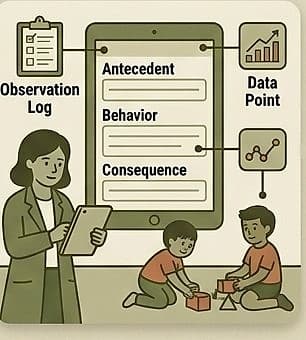
This subtopic connects directly back to Module 2.7 and applies it specifically to formal written documentation. A behavioral observation note is only as useful as it is specific, and the ABC framework from Module 2.2 provides the natural structure for writing these notes well.
A strong behavioral observation entry typically includes: the setting and context (where, when, who was present); the antecedent (what happened immediately before); an operationally defined description of the behavior itself (specific enough that another clinician reading it would picture the same thing you saw); the duration, frequency, or intensity of the behavior, quantified wherever possible; the consequence (what happened immediately after, including how adults or peers responded); and, separately and clearly labeled, any clinical interpretation of function or pattern.
Compare these two entries for the same event. Weak: "Malik had a meltdown during circle time again today." Strong: "During circle time (approx. 10 minutes into a 20-minute group activity), Malik was asked to put away a preferred toy car before joining the group (antecedent). He screamed loudly, threw the car onto the floor, and dropped to a seated position on the ground for approximately 90 seconds (behavior). The teaching assistant removed him from the group to a quiet corner, and circle time continued without him (consequence). This is the third similar episode recorded this week, in each case following removal of a preferred item just before a transition to a less-preferred group activity -- a pattern consistent with an escape function, to be discussed further at next team meeting."
Notice that the strong version is not simply longer -- it is structured, quantified, and separates observation from interpretation, exactly per the standards from Modules 5.1 and 5.2. It also explicitly references the pattern across multiple occasions (Module 2.3) rather than treating this as an isolated incident.
It is also worth documenting negative findings -- that is, noting when an expected or previously reported behavior did not occur, which is itself clinically meaningful information (for example, noting that a child successfully transitioned away from a preferred activity without incident, if that has previously been a consistent problem, is valuable progress data, not a note not worth making).
Practical takeaway: Build every behavioral note around the ABC structure by default, quantify whenever you can, and always note whether this is a new pattern or a continuation of one you've already documented -- this is what makes trajectory-tracking (Module 1.6) possible later.
This guide is general information, not a diagnosis or medical advice. If you're worried about your child, the next step is a conversation with a qualified therapist.
Keep reading
More for your practice
Structured courses with completion tracking live in your therapist dashboard.