
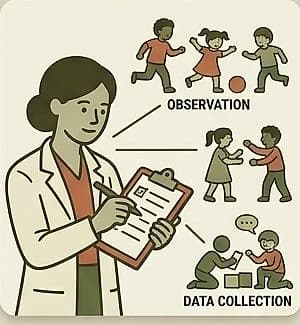
This is the first topic in Module 2 of Hayven's therapist training curriculum, Behavioral Assessment & Understanding Behavior. The goal of this module is to teach you how to understand why a child behaves a certain way rather than simply labeling the behavior; by the end of it, you should be able to observe a behavior, identify potential triggers and functions, and document it appropriately.
Behavioral assessment is the process of systematically observing, measuring, and analyzing a child's behavior to understand what is causing or maintaining it -- rather than simply describing the behavior and stopping there. It is the difference between saying "this child is aggressive" (a label) and saying "this child hits peers during unstructured play, roughly three times per session, most often within one minute of being asked to share a toy" (an assessment).
Labels feel efficient but are clinically weak because they describe the child, not the situation, and they offer no guidance for what to do differently. Behavioral assessment reframes the question from "what is wrong with this child?" to "what is happening around this child, right before and right after the behavior, that is making it more or less likely to occur again?" This reframing is powerful because it points directly to something you can change -- the environment, the triggers, and the responses the behavior receives -- rather than something you usually cannot change quickly, like a child's underlying temperament or diagnosis.
Good behavioral assessment rests on a few core principles: behavior is observable and measurable (you should be able to describe it so precisely that two different people watching the same moment would agree it happened); behavior serves a purpose or function for the child, even when that function is not obvious; behavior is influenced by the surrounding context, not just internal traits; and behavior can be changed by changing the conditions around it, once its function is understood.
For a new therapist, the practical shift this requires is training yourself to describe before you interpret. When you see a child throw a toy, your first written note should capture exactly what happened -- who was present, what had just occurred, what the child did, and what happened immediately afterward -- before you form any theory about "why." This discipline is what separates a useful clinical observation from a casual, potentially biased impression.
Practical takeaway: Every time you are tempted to write a label ("defiant," "attention-seeking," "manipulative"), stop and instead write the specific, observable sequence of events. The label can come later, if it's needed at all -- the sequence is what actually helps.
This guide is general information, not a diagnosis or medical advice. If you're worried about your child, the next step is a conversation with a qualified therapist.
Keep reading
More for your practice
Structured courses with completion tracking live in your therapist dashboard.