
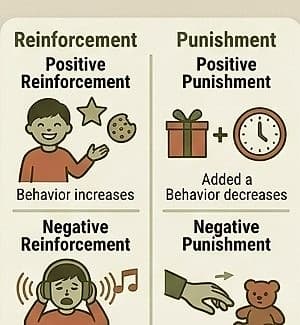
Once you understand the function of a behavior, the next building block is understanding how consequences shape whether a behavior increases or decreases over time. In psychology, this comes from the principles of operant conditioning, and it is one of the most misunderstood pairs of terms in everyday language -- largely because "negative" is often mistaken for "bad" or "punishing," when in this context it simply means "removing something."
There are four basic categories (UCF Pressbooks, "Reinforcement and Punishment"). Positive reinforcement: adding a desirable stimulus to increase a behavior. Example: a child cleans their room and receives praise or a small reward, making them more likely to clean up again. Negative reinforcement: removing an unpleasant stimulus to increase a behavior. Example: a car's seatbelt alarm stops beeping once the seatbelt is fastened, which increases the likelihood the driver buckles up promptly next time; in a child example, a child who is allowed to leave an overwhelming, loud room after asking to leave is more likely to ask to leave again in the future -- the removal of the unpleasant noise reinforced the asking behavior.
Positive punishment: adding an unpleasant consequence to decrease a behavior. Example: a natural consequence like a stern verbal correction following an unsafe action. Negative punishment: removing something pleasant to decrease a behavior. Example: a time-out removes access to a fun activity, which is intended to decrease the behavior that led to it.
The single most important thing to remember: reinforcement (positive or negative) always increases the future likelihood of a behavior, and punishment (positive or negative) always decreases it. "Negative" does not mean "bad" and "positive" does not mean "good" -- they simply describe whether something was added (positive) or removed (negative) from the situation.
This matters enormously in clinical practice because it is very easy to unintentionally reinforce a behavior you are trying to reduce. If a child screams (behavior) to avoid a task, and a well-meaning adult removes the task to calm the child down (consequence), the adult has just negatively reinforced screaming -- even though their intention was simply to de-escalate. Recognizing this pattern is often the "aha moment" for new therapists: many challenging behaviors persist not because caregivers are doing something obviously wrong, but because they are unknowingly reinforcing the very behavior they want to reduce, usually through escape or attention.
Practical takeaway: Before recommending any intervention, ask what is currently reinforcing the unwanted behavior, and design a plan that reinforces a more appropriate replacement behavior serving the same function instead of simply trying to punish the original behavior away.
This guide is general information, not a diagnosis or medical advice. If you're worried about your child, the next step is a conversation with a qualified therapist.
Keep reading
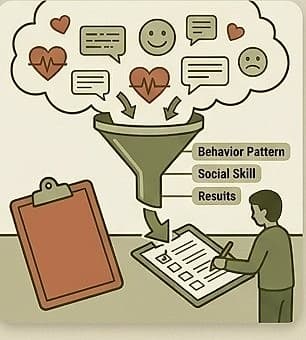
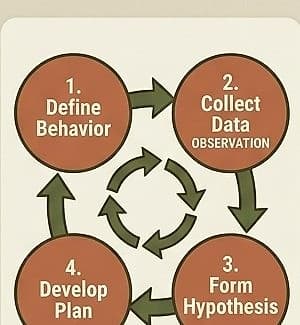
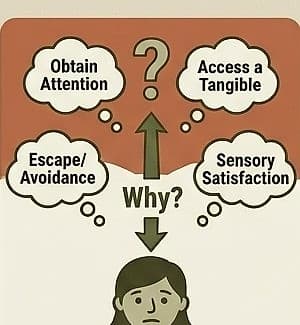
More for your practice
Structured courses with completion tracking live in your therapist dashboard.