
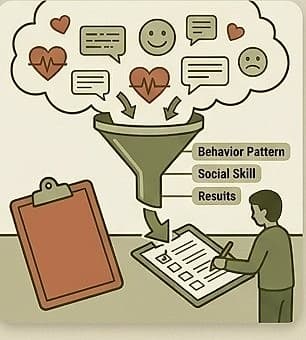
2.7 Turning Observations into Useful Clinical Information
6 min read
The final skill in this module is translation: converting a session's worth of raw observation into something that is actually useful to you, to a supervisor, and to the family. Raw observation notes are only clinically valuable if they are specific, organized, and connected to a purpose.
Write the behavior operationally. An operational definition describes a behavior so precisely that two independent observers watching the same moment would agree on whether it occurred. "Aggressive" is not operational. "Hit another child with an open hand" is. This single habit, used consistently, removes most subjectivity from your notes before it even starts.
Always record the full ABC sequence, not just the behavior. A note that says only "child cried for 5 minutes" throws away the two most clinically useful pieces of information: what triggered it and what happened afterward. Train yourself to never write down a behavior without also capturing what came immediately before and immediately after.
Quantify wherever possible. Instead of "cried a lot," write "cried for approximately 4 minutes, occurring 3 times in a 45-minute session." Numbers make it possible to compare across sessions and actually track whether an intervention is working -- this connects directly to trajectory-tracking (Module 1.6) and to progress documentation (Module 5).
Separate observation from interpretation, but include both, clearly labeled. It's fine, and often useful, to add a clinical impression ("this pattern is consistent with an escape function based on today's ABC data"), but it should always be clearly distinguishable from the raw observation itself, so that anyone reading the note later can see exactly what was seen versus what was concluded.
Connect the observation to a next step. A good clinical observation doesn't just describe the past -- it points toward a decision: continue monitoring, adjust the intervention, refer for further assessment, or share a specific update with the caregiver. If your note doesn't lead anywhere, it usually means you haven't yet identified what matters most about what you saw.
Practical takeaway: Before finalizing any behavioral note, run it through this checklist: is the behavior described operationally? Is the full ABC sequence present? Is it quantified where possible? Is interpretation clearly separated from observation? Does it point to a next step? If yes to all five, the note is doing its job.
Module 2 references: IRIS Center, Vanderbilt University, "The ABC Model" (iris.peabody.vanderbilt.edu/module/bp/cresource/q1/p02/); IRIS Center, Vanderbilt University, "Descriptive Assessments" (iris.peabody.vanderbilt.edu/module/fba-elem/cresource/q2/p06/); CrossRiver Therapy, "Four Functions of Behavior in ABA Therapy" (crossrivertherapy.com/aba-therapists/four-functions-of-behavior); UCF Pressbooks (Lumen Learning), "Reinforcement and Punishment" (pressbooks.online.ucf.edu/lumenpsychology/chapter/operant-conditioning/); Indiana FSSA, "ABC (Antecedent-Behavior-Consequence) Model" (in.gov/fssa/ddars/files/AssistedSupports_BS_BT_ABC_V2.pdf).
This guide is general information, not a diagnosis or medical advice. If you're worried about your child, the next step is a conversation with a qualified therapist.
Keep reading
More for your practice
Structured courses with completion tracking live in your therapist dashboard.