
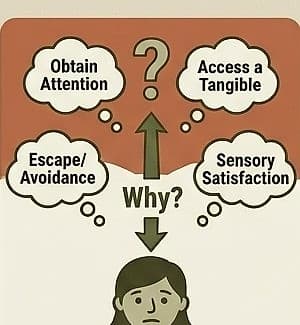
The "function" of a behavior is the purpose it serves for the child -- what the child gets, or avoids, by doing it. Understanding function is the single most important shift a new therapist can make, because two behaviors that look identical on the surface can have completely different functions, and effective intervention absolutely depends on getting the function right.
Applied behavior analysis literature typically organizes behavioral functions into four broad categories (CrossRiver Therapy, "Four Functions of Behavior in ABA Therapy"; Leafwing Center; Action Behavior Centers). Escape or avoidance: the behavior allows the child to get out of, delay, or avoid something unpleasant -- a difficult task, an overwhelming environment, or an uncomfortable social interaction. Example: a child puts their head down and refuses to work whenever a hard worksheet is presented.
Attention: the behavior reliably produces attention from an adult or peer, even if that attention is a scolding rather than praise -- to many children, negative attention is still far better than no attention at all. Example: a child screams whenever their parent is occupied with something else, and the parent immediately comes over to ask what's wrong. Access to tangibles or activities: the behavior gets the child a desired object, food, or activity. Example: a child cries loudly until they are given a toy or allowed to watch a preferred show.
Sensory / automatic reinforcement: the behavior itself feels good or provides relief, independent of any other person's reaction -- for example, rocking, hand-flapping, or covering ears in a loud environment. This function does not depend on anyone responding at all, which is what makes it harder to identify and to change.
The same surface behavior -- say, a child screaming -- could serve any of these four functions in different children, or even in the same child in different situations. This is exactly why the label "attention-seeking" is used so loosely and so inaccurately in casual settings: it is one possible function among several, and assuming it without evidence often leads to the wrong intervention (for example, deliberately ignoring a behavior that is actually escape-motivated will not reduce it -- it may simply teach the child to escalate until the demand is dropped).
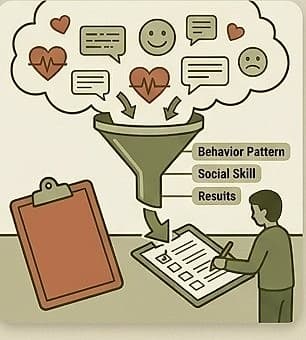
To determine function, look at the ABC data you have already collected and ask specifically: what did the child get, or get out of, immediately after the behavior? If the demand was removed, that points to escape. If an adult came over, that points to attention. If a desired object appeared, that points to tangible access. If nothing external changed but the behavior still continued or increased, that points to a sensory/automatic function.
Practical takeaway: Never assume a function from the behavior's appearance alone. Always trace it back to the consequence column of your ABC data -- the function is revealed by what actually happens after the behavior, not by how dramatic or disruptive the behavior looks.
This guide is general information, not a diagnosis or medical advice. If you're worried about your child, the next step is a conversation with a qualified therapist.
Keep reading
More for your practice
Structured courses with completion tracking live in your therapist dashboard.