
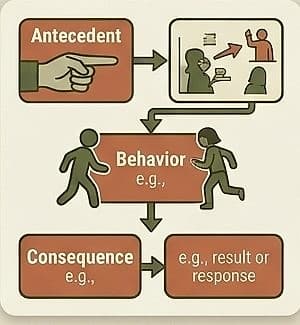
The ABC model is the single most useful tool in behavioral assessment, and it is simple enough to use from your very first week on the job. It breaks any behavioral episode into three parts.
Antecedent (A) is whatever happens immediately before the behavior -- the trigger or setting event. This can be something specific (a demand was placed, a toy was taken away, a transition was announced) or more general (the child is tired, hungry, or in a loud environment). Behavior (B) is the observable, measurable action itself -- described specifically enough that another observer would recognize it (e.g. "child screamed for approximately 10 seconds and dropped to the floor," not "child had a tantrum"). Consequence (C) is whatever happens immediately after the behavior -- how the environment, caregiver, or peers responded.
The IRIS Center at Vanderbilt University, a widely used training resource in special education and behavioral training, describes the ABC model this way: antecedents and consequences can occur naturally in the environment, and they can also be deliberately used to change behavior -- because what happens before and after a behavior directly affects how likely that behavior is to happen again (IRIS Center, "The ABC Model"). For example: if a teacher gives an instruction (antecedent), a child completes the task (behavior), and the teacher praises them (consequence), the praise may make task completion more likely next time. If a child refuses to share (behavior) and the peer simply walks away to play elsewhere (a natural consequence), that outcome may discourage the refusal in the future -- or, just as easily, may reinforce it if being left alone was what the child wanted.
To use the ABC model in real time, it helps to have a simple three-column recording sheet. Every time the target behavior occurs, write down what happened right before, describe the behavior itself in neutral terms, and write down what happened right after -- including who responded, how, and how quickly. Collecting this across multiple occasions, not just one, is essential, because a single instance can be a coincidence, while a pattern across five or ten instances reveals something real.
Practical takeaway: Carry an ABC data sheet (paper or digital) into every observation session. Even a rough, quickly-jotted ABC note is more clinically useful than a polished paragraph written from memory an hour later.
This guide is general information, not a diagnosis or medical advice. If you're worried about your child, the next step is a conversation with a qualified therapist.
Keep reading
More for your practice
Structured courses with completion tracking live in your therapist dashboard.