
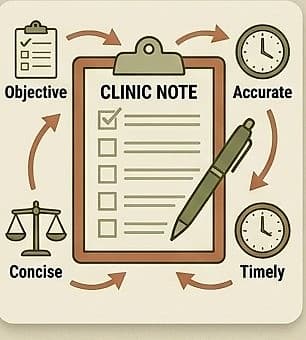
This is the first topic in Module 5 of Hayven's therapist training curriculum, Writing Better Clinical & Progress Reports. The goal of this module is to help you turn observations and session information into useful documentation; by the end of it, you should be able to produce clear, objective, and useful clinical documentation.
A clinical note has one core job: to allow anyone who reads it later -- including your future self, a supervisor, another clinician taking over the case, or an insurance reviewer -- to understand exactly what happened, why it matters, and what should happen next, without needing to ask you directly.
Good clinical notes share several consistent qualities. They are specific and concrete rather than vague, describing exact behaviors, frequencies, and durations rather than general impressions. They are objective, clearly separating what was directly observed from clinical interpretation (this is expanded fully in Module 5.2). They are complete, including all clinically relevant elements for the note type being used (mood/presentation, interventions used, the client's response, and any plan for next steps, at minimum). They are consistent, using the same terminology, abbreviations, and format across sessions and across a clinic's clinicians, so that anyone reading a chart over time can track a coherent story rather than stumbling over shifting conventions. And they are timely, written as close to the session as possible, since memory of specific details degrades quickly.
A widely used structural framework for clinical notes is SOAP: Subjective (what the client/caregiver reports, in their own words or close to it), Objective (what you directly observed or measured -- behaviors, test results, direct quotes of what was said, durations, frequencies), Assessment (your clinical interpretation, synthesizing subjective and objective information), and Plan (what happens next -- continued intervention, referral, follow-up timeline) (NCBI/StatPearls, "SOAP Notes"). Other formats exist (such as BIRP: Behavior, Intervention, Response, Plan) and serve a similar underlying purpose -- forcing the writer to separate description from interpretation and to always end with a forward-looking plan.
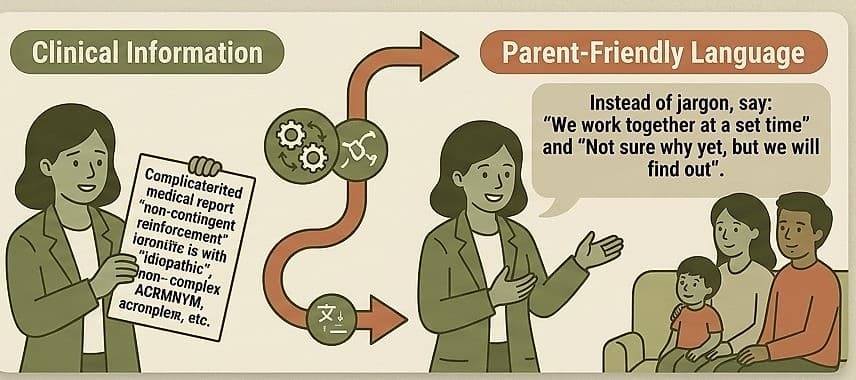
It is worth remembering that clinical notes serve multiple audiences and purposes simultaneously: they support continuity of care (helping you or a colleague pick up where you left off), they support accountability and legal/insurance documentation (demonstrating that appropriate, medically necessary care was provided), and, often underappreciated by new therapists, they are the raw material for tracking a child's trajectory over time (Module 1.6) and for producing parent-friendly progress summaries (Module 5.8).
Practical takeaway: Before finalizing any note, ask: if I left this job tomorrow, could a new therapist pick up this chart and know exactly what has been tried, what worked, and what should happen next? If not, the note needs more specificity.
This guide is general information, not a diagnosis or medical advice. If you're worried about your child, the next step is a conversation with a qualified therapist.
Keep reading
More for your practice
Structured courses with completion tracking live in your therapist dashboard.