
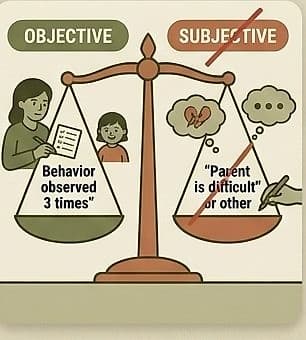
The distinction between objective and subjective language is one of the most important -- and most commonly blurred -- skills in clinical writing. Getting this right protects the accuracy and credibility of your documentation.
Subjective information is what the client or caregiver reports -- their own experience, feelings, or perspective, ideally recorded close to their actual words. Example: "Mother reports that Ade 'melts down every night at bedtime' and feels 'exhausted and out of ideas.'" This is valuable information, but it is one person's perspective, not an independently verified fact.
Objective information is what you directly observed or measured -- something that another trained observer watching the same moment would also record. Example: "During the 30-minute session, child cried for a total of approximately 6 minutes across three separate episodes, each following a transition away from a preferred toy." A helpful distinction from clinical documentation guidance is that a symptom is the patient's/family's subjective description of a problem, while a sign is an objective, observable finding related to that same problem (NCBI/StatPearls, "SOAP Notes").
The most common documentation error new therapists make is writing clinical interpretations as if they were objective observations. "Client was anxious" is not objective -- anxiety is an internal state you cannot directly observe. What you can observe are the specific signs that led you to that interpretation: "Client's hands were visibly shaking, they repeatedly asked 'is this going to hurt?', and they required three verbal prompts before initiating the task." The interpretation ("this presentation is consistent with anxiety about the task") belongs in the Assessment section, clearly labeled as your clinical judgment -- not disguised as raw observation.
This distinction matters for a very practical reason: objective, specific documentation can be independently verified and is far more defensible (clinically, legally, and for insurance purposes) than subjective-sounding documentation dressed up as fact. It also produces more useful long-term records, because "client was anxious" tells a future reader almost nothing actionable, while the specific behavioral description gives them something they could actually compare against on a later date.
Practical takeaway: For every sentence you write in an Objective section, ask: "Could someone else, watching the exact same moment, have written this same sentence without needing to read my mind?" If the answer is no, it belongs in Assessment instead, clearly labeled as interpretation.
This guide is general information, not a diagnosis or medical advice. If you're worried about your child, the next step is a conversation with a qualified therapist.
Keep reading
More for your practice
Structured courses with completion tracking live in your therapist dashboard.