
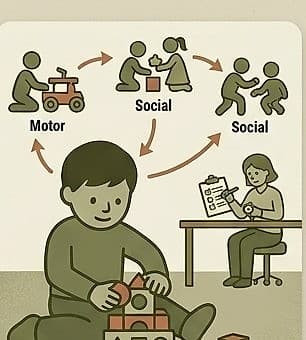
Direct observation of the child is the piece of assessment that cannot be substituted by parent report or standardized testing alone -- it is where you see, first-hand, how the child actually engages with people, materials, and demands.
Effective observation is structured, not incidental. Before you begin, decide what you are watching for: is it play skills, social engagement, response to specific demands, or language use? Having a specific lens prevents you from either missing important behavior or being overwhelmed trying to track everything at once.
A few dimensions worth systematically noting during any child observation: how the child separates from the caregiver at the start of the session (easily, with distress, needing extended reassurance); how the child explores unfamiliar materials or space (curious and exploratory, cautious, avoidant, or disorganized); how the child interacts with you as an unfamiliar adult (warms up quickly, is guarded, seeks excessive reassurance, ignores your presence); how the child manages a mildly frustrating or non-preferred task (persists, becomes distressed, gives up quickly, seeks help appropriately); and how the child communicates (verbally, through gesture, through behavior) across the session.
Play observation deserves special attention because play is one of the richest and most naturalistic windows into a young child's cognitive, language, and social-emotional functioning. Watch for the type of play present -- is it purely sensory/exploratory (mouthing, banging, dumping), functional (using a toy phone as a phone), constructive (building or creating something), or symbolic/pretend (using a block as a "car," assigning roles in play)? Symbolic pretend play, in particular, typically emerges in the second year of life and becomes richer through the preschool years, and its presence or absence is a meaningful data point for cognitive and social development.
It is important to remember that a single observation session is a snapshot, often taken in an unfamiliar setting with an unfamiliar adult -- children may be unusually shy, unusually well-behaved, or unusually dysregulated compared to their everyday baseline. This is exactly why observation should always be combined with caregiver report (Module 3.3) rather than treated as the sole source of truth.
Practical takeaway: Decide your observational focus before the session starts, take notes in the moment rather than relying on memory afterward, and always weigh a single observation session against caregiver report of the child's typical behavior across settings.
This guide is general information, not a diagnosis or medical advice. If you're worried about your child, the next step is a conversation with a qualified therapist.
Keep reading

More for your practice
Structured courses with completion tracking live in your therapist dashboard.