
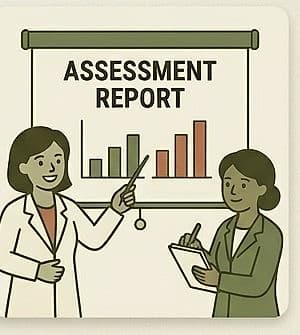
An assessment's clinical value is only realized if its findings are communicated in a way the receiving audience -- usually caregivers, sometimes other professionals -- can actually understand and act on. Communicating findings well is a distinct skill from gathering and interpreting them.
A few well-supported practices make this communication effective (Kaplan Early Learning, "7 Tips for Sharing Assessment Results"; ECTA Center, "Talking with Families about Assessment Results"). Schedule dedicated time: findings should be discussed in a focused conversation, not squeezed into a rushed hallway moment or the last two minutes of a session. Families need space to process and ask questions. Explain the purpose and process first: before sharing results, briefly explain what was assessed and how, so the findings land in context rather than as an unexplained verdict.
Lead with strengths: beginning with what the child does well, even in a report focused mainly on concerns, reduces defensiveness and helps caregivers stay engaged rather than shutting down emotionally, which paradoxically makes it easier for them to absorb the more difficult parts of the findings afterward. Use plain language, not jargon: terms like "expressive language delay" or "sensory-seeking behavior" mean nothing to most caregivers on first hearing them. Explain technical terms in everyday language, and check understanding by inviting questions rather than assuming silence means comprehension.
Acknowledge setting differences respectfully: when your observations differ from a caregiver's report (Module 3.3), acknowledge this without implying the caregiver is wrong -- differences in behavior across settings are normal and expected, not evidence that either observation was mistaken. End with clear next steps: a feedback conversation should never end ambiguously. Caregivers should leave knowing exactly what is recommended, why, and what happens next (referral, follow-up timeline, home strategies, etc.).
Follow up in writing: a written summary that caregivers can revisit later (since it is well documented that people retain only a fraction of what they hear in an emotionally significant conversation) reinforces and clarifies what was discussed verbally. This entire subtopic connects directly forward to Module 4 (the relationship and communication skills needed to deliver feedback well) and to Module 5 (writing the actual documents that carry these findings forward).
Practical takeaway: Structure every feedback conversation the same way: purpose, then strengths, then findings in plain language, then next steps, then written follow-up. This structure alone prevents the most common feedback mistakes -- jargon overload and ambiguous endings.
Module 3 references: Yale Medicine, "Psychological Assessment of Children" (yalemedicine.org/conditions/pediatric-psychological-assessment); AMBOSS Resident 360, "Developmental History" (resident360.amboss.com/pediatrics/developmental-and-behavioral-pediatrics/developmental-history/developmental-history.html); Journal of the American Academy of Psychiatry and the Law (JAAPL), "Controlling for Confirmation Bias in Child Sexual Abuse Interviews" (jaapl.org/content/early/2021/05/19/jaapl.200109-20); ScienceDirect Topics, "Confirmation Bias" (sciencedirect.com/topics/psychology/confirmation-bias); Kaplan Early Learning Company, "7 Tips for Sharing Assessment Results That Strengthen Family Partnerships" (blog.kaplanco.com/sharing-assessment-results-that-strengthen-family-partnerships); ECTA Center, "Talking with Families about Assessment Results" (ectacenter.org/~pdfs/eco/COS-TC_Training_Scenario1_Talking_Families_March_2017.pdf).
This guide is general information, not a diagnosis or medical advice. If you're worried about your child, the next step is a conversation with a qualified therapist.
Keep reading

More for your practice
Structured courses with completion tracking live in your therapist dashboard.