
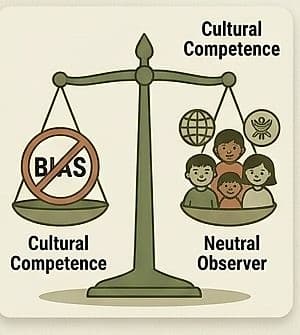
Bias is not a sign of a bad clinician -- it is a normal feature of human judgment that every clinician is vulnerable to, and the goal of training is not to eliminate it entirely but to recognize it and build in safeguards against it.
Confirmation bias is the tendency to notice, weigh, and remember information that confirms what you already suspect, while overlooking information that contradicts it. In assessment, this often shows up when a referral note primes you with an expectation (e.g. "possible autism") before you ever see the child, and you then unconsciously interpret ambiguous behaviors as confirming that expectation rather than considering them neutrally. Clinical and forensic literature on child assessment specifically warns that confirmation bias can distort interviews and evaluations, and recommends actively considering disconfirming evidence and alternative hypotheses as a structured safeguard (JAAPL, "Controlling for Confirmation Bias in Child Sexual Abuse Interviews"; ScienceDirect, "Confirmation Bias").
Halo effect is the tendency to let one positive or negative impression color your judgment of unrelated traits -- for example, assuming a well-spoken, well-dressed child is also socially and emotionally well-adjusted, or assuming a child who is initially uncooperative in the session must have broader behavioral problems. Anchoring bias occurs when your first piece of information (a referral label, a first impression, or an initial low score) disproportionately shapes everything that follows, even when later evidence should update that impression.
Cultural bias is applying norms drawn from one cultural context to a child from a different one, mistaking a cultural difference for a deficit -- directly connecting back to Module 1.5. This is one of the most consequential biases in child assessment because it can lead to over-identification of concerns in children from backgrounds different from the clinician's own, or under-identification when clinicians overcorrect and dismiss real concerns as "just cultural." Single-source overreliance is treating one source of information (often whichever was gathered first, or whichever the clinician trusts most) as sufficient, rather than requiring convergence across interview, observation, and testing as described in Module 3.6.
Practical safeguards against these biases include: deliberately generating at least one alternative hypothesis for every finding before settling on a conclusion; gathering information from multiple independent sources before forming a judgment, rather than during or immediately after receiving the referral note; asking a colleague or supervisor to review ambiguous cases with fresh eyes; and explicitly asking about cultural and environmental context (Module 1.5) as a standard, non-optional part of every assessment.
Practical takeaway: Build in a deliberate pause between gathering information and forming a conclusion, and use that pause to actively ask, "What would change my mind about this?" If you can't answer that question, you may be anchored on an early impression rather than genuinely weighing the evidence.
This guide is general information, not a diagnosis or medical advice. If you're worried about your child, the next step is a conversation with a qualified therapist.
Keep reading

More for your practice
Structured courses with completion tracking live in your therapist dashboard.