
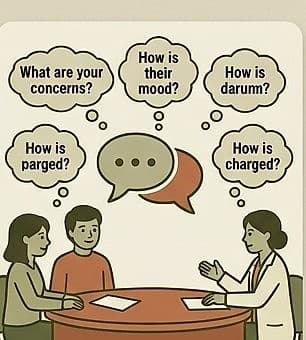
The caregiver interview is where most of your developmental and psychosocial history is actually gathered, and doing it well is a distinct skill from simply asking a checklist of questions.
Begin with open-ended questions before narrowing to specifics. "Tell me about your child" or "What brought you in today?" invites caregivers to share what matters most to them, often revealing priorities and concerns you would not have thought to ask about directly. Only after this open exploration should you move to more targeted, specific questions to fill in gaps.
Be alert to the difference between what a caregiver reports and what you can verify through direct observation -- both matter, but they are not interchangeable. A parent's description of a behavior at home is valuable context, but your own observation of the child in the session gives you a second, independent data point. When the two disagree (a caregiver describes a child as "never sitting still" but the child sits calmly through your entire session), that discrepancy itself is useful clinical information -- it may reflect setting differences (children often behave differently in a novel one-on-one setting than in a busy home with siblings), caregiver stress or perception, or something worth exploring further.
Practical interviewing techniques worth building early: reflect back what you hear to confirm understanding ("So what I'm hearing is that mealtimes have become a major stress point -- is that right?"); avoid leading questions that suggest the answer you expect ("He gets frustrated a lot, doesn't he?" versus "How does he typically respond when he's frustrated?"); and normalize sensitive topics before asking about them directly (briefly explaining why you're asking about family mental health history, for example, before asking, reduces defensiveness).
It is also worth interviewing more than one caregiver when possible, and asking about the child's presentation across different settings (home, school, with each parent, with other caregivers) -- behavior that is consistent across settings is more likely to reflect something intrinsic to the child, while behavior that is highly setting-specific often points to an environmental or relational factor instead.
Practical takeaway: Start broad, narrow down, and always note both what caregivers report and what you personally observe -- treating any disagreement between the two as useful information rather than an inconvenience to resolve quickly.
This guide is general information, not a diagnosis or medical advice. If you're worried about your child, the next step is a conversation with a qualified therapist.
Keep reading


More for your practice
Structured courses with completion tracking live in your therapist dashboard.