
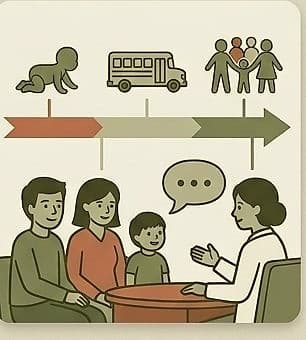
The developmental and psychosocial history is the backbone of any child assessment -- it gives you the context needed to correctly interpret everything you observe afterward. Without it, you risk assessing a child's current behavior in a vacuum, disconnected from the factors that actually explain it.
A thorough developmental history generally covers (AMBOSS Resident 360, "Developmental History"): prenatal and birth history (type of pregnancy and any complications, maternal exposures during pregnancy, gestational age at birth, birth complications, and Apgar scores or NICU admission if applicable); early medical history (significant illnesses, hospitalizations, head injuries, seizures, or chronic conditions); milestone attainment (age at which major motor, language, cognitive, and social milestones were reached, and specifically whether any skill was ever lost after being gained -- regression is always worth asking about directly, since caregivers do not always volunteer it unprompted).
It also covers family history (a multi-generational look at developmental, learning, psychiatric, and genetic conditions in the family, since many developmental and behavioral conditions have a hereditary component); social history (the child's living situation, caregivers, any history of major stressors such as parental separation, moves, loss, or exposure to conflict, and social determinants of health such as housing or food security); and current supports (whether the child currently receives or has received early intervention services, an Individualized Education Program, a 504 plan, or other therapies, and how those are going).
Psychosocial history extends this further into the child's everyday emotional and relational world: family structure and relationships, peer relationships, school or daycare adjustment, sleep and appetite patterns, and any major life events. This information matters because behavior and development cannot be separated from context -- a sudden change in behavior makes far more sense once you learn the family moved houses or a parent recently returned from working abroad.
A practical structure many clinicians use is to move chronologically: start with pregnancy and birth, move through infancy and early milestones, then current daily life and social context. This chronological approach is easier for caregivers to follow and less likely to feel like an interrogation than jumping between topics.
Practical takeaway: Always explicitly ask about regression (loss of previously acquired skills) and about major life changes or stressors -- these two categories of information are the most commonly missed when history-taking is rushed, and both are highly clinically significant.
This guide is general information, not a diagnosis or medical advice. If you're worried about your child, the next step is a conversation with a qualified therapist.
Keep reading

More for your practice
Structured courses with completion tracking live in your therapist dashboard.