
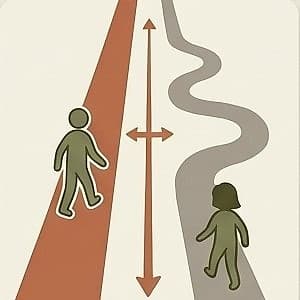
Not every child who is "different" from the milestone chart has a problem. This is one of the most important distinctions a new therapist must learn, because over-pathologizing normal variation causes unnecessary anxiety for families, while under-recognizing a true concern delays help a child needs.
A developmental variation is a difference in the timing or style of development that still falls within a healthy range. Children are not identical; some walk at 10 months and some walk at 16 months, and both can be entirely typical. Variation can come from temperament, birth order, amount of practice/opportunity, bilingual home environments (which can temporarily affect vocabulary size in each individual language, though total communicative competence is usually on track), or simply individual differences in the pace of brain maturation.
A developmental concern, on the other hand, is a pattern that falls meaningfully outside the expected range, especially when it involves multiple domains, is getting worse rather than better, or includes loss of a skill the child previously had (regression). Developmental delay can be classified as isolated (one domain affected, such as motor only), multiple (two or more domains), or global (most domains significantly affected) (NCBI/StatPearls, "Developmental Delay"). Global delays are generally viewed more seriously because they suggest a broader underlying issue rather than a domain-specific difference in pace.
The clinical skill here is pattern recognition over time, not a single snapshot. A single missed milestone at a single visit is a data point, not a diagnosis. What matters is: is this consistent? Is it isolated to one domain or spread across several? Is the gap widening or narrowing as the child gets older? Did the child ever have the skill and lose it?
A simple decision aid for new therapists: ask three questions. First, is this a delay in timing (the skill will likely appear, just later), or an atypical pattern (the skill is developing in a qualitatively unusual way, e.g. unusual hand-flapping instead of typical exploratory play)? Second, is it isolated to one domain, or affecting several at once? Third, is there any loss of a previously acquired skill? If the answer to the third question is yes, or the second shows multiple domains, this moves from "watchful waiting" territory into "refer for a full evaluation" territory.
Practical takeaway: Always document what you observe in neutral, descriptive terms first ("does not yet combine words") before you label it a variation or a concern. The label follows the data, not the other way around.
This guide is general information, not a diagnosis or medical advice. If you're worried about your child, the next step is a conversation with a qualified therapist.
Keep reading


More for your practice
Structured courses with completion tracking live in your therapist dashboard.