
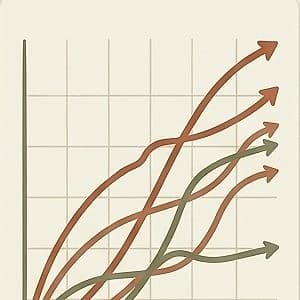
A developmental trajectory is the path a child's development follows over time, not just their position at a single point in time. Two children can look identical at age 3 and have completely different trajectories -- one steadily catching up, the other steadily falling further behind -- and that difference in direction matters more clinically than the single snapshot.
This is why ongoing developmental surveillance (regularly checking in on development at each visit, not just doing one screening and closing the file) is recommended over one-time screening alone. The CDC frames this as combining structured screening at key ages (9, 18, and 30 months, plus autism screening at 18 and 24 months) with everyday surveillance -- watching, listening, and tracking progress at every contact with the child (CDC, "Learn the Signs. Act Early.").
Understanding trajectories requires you to think in terms of rate of progress, not just presence or absence of a skill. Four trajectory patterns are worth recognizing. A steady, typical trajectory means the child continues to gain new skills at a pace consistent with peers, and no action is needed beyond routine monitoring. A delayed but progressing trajectory means the child is behind peers but is still steadily acquiring new skills, just more slowly, and the gap is not widening -- this often warrants monitoring, targeted support, or early intervention, but is not automatically an emergency.
A widening-gap trajectory means the child is falling further behind over time rather than simply starting behind -- the gap between the child and same-age peers increases at each check-in, which is a stronger signal for a comprehensive evaluation. A plateau or regression trajectory means the child stops gaining new skills altogether, or loses skills they previously had; this is the most serious pattern and should always prompt immediate referral, since regression is associated with a range of neurological and developmental conditions that benefit strongly from early identification.
Because trajectories can only be seen over time, documentation is what makes trajectory analysis possible. If your notes from three months ago simply say "delayed speech" and your notes today say the same thing, you cannot tell whether the child is making progress, standing still, or regressing -- you have thrown away the most clinically useful information you had. This is why Module 5 emphasizes specific, measurable documentation: it is what turns a series of appointments into a trajectory you can actually interpret.
Practical takeaway: Every time you see a returning child, compare today's observations to your own prior notes, not just to the general milestone chart. The direction of change over time is often more diagnostically useful than where the child sits on any single day.
Module 1 references: CDC, "Learn the Signs. Act Early." -- Milestone Checklists by Age (cdc.gov/act-early/resources/milestones-checklist-by-age.html); CDC, "CDC's Developmental Milestones" (cdc.gov/act-early/milestones/index.html); NCBI Bookshelf (StatPearls), "Developmental Stages of Social Emotional Development in Children" (ncbi.nlm.nih.gov/books/NBK534819/); NCBI Bookshelf (StatPearls), "Developmental Delay" (ncbi.nlm.nih.gov/books/NBK562231/); Skillpoint Therapy, "Developmental Delay: Red Flags by Age" (skillpointtherapy.com/developmental-delay-by-age/); Maryville University, "Cultural Influences on Child Development" (online.maryville.edu/blog/cultural-influences-on-child-development/); The Conversation / Bournemouth University, "How culture influences children's development" (theconversation.com/how-culture-influences-childrens-development-99791).
This guide is general information, not a diagnosis or medical advice. If you're worried about your child, the next step is a conversation with a qualified therapist.
Keep reading



More for your practice
Structured courses with completion tracking live in your therapist dashboard.