
1.2 Cognitive, Emotional, Social, and Language Development
6 min read
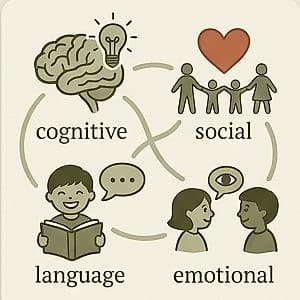
Children develop across several parallel "tracks," and it helps to understand each one separately, even though in real life they are constantly interacting with each other.
Cognitive development refers to how a child thinks, learns, pays attention, remembers, and solves problems. In infancy this looks like exploring objects by mouthing or banging them; in the preschool years it grows into symbolic thinking (using one object to represent another in pretend play), counting, and understanding cause and effect; by school age, children can hold multiple ideas in mind, plan ahead, and reason more logically.
Language and communication development includes both receptive language (understanding what others say) and expressive language (using words, gestures, or other tools to communicate). It moves from cooing and babbling in infancy, to first words around 12 months, to short phrases around 18-24 months, to full sentences and storytelling by the preschool years.
Social-emotional development is about how a child understands, expresses, and manages emotions, and how they relate to others. This one is especially important for therapists to understand in detail because so many referrals are related to social-emotional difficulties. A rough progression looks like this: social smiling appears around 1-2 months; back-and-forth "conversations" (cooing, gesturing) develop around 4-5 months; attachment to caregivers solidifies between 6-12 months, along with stranger anxiety and joint attention (looking where someone else is pointing); pointing and early empathy appear between 12-18 months; a strong drive for autonomy and the start of pretend play emerge between 18-30 months; and impulse control, awareness of gender, and real peer relationships develop between 30-54 months (NCBI/StatPearls, "Developmental Stages of Social Emotional Development in Children").
Two theoretical ideas are worth knowing here. Erik Erikson described "basic trust versus mistrust" as the first psychosocial task of infancy -- babies who experience consistent, responsive caregiving learn that the world is safe and predictable, which becomes the emotional foundation for everything that follows. Attachment theory adds that a child with a secure attachment to a caregiver uses that adult as a "secure base" to explore the world and a "safe haven" to return to when upset. Temperament also matters: children are sometimes broadly described as easy, active/spirited, or slow-to-warm-up, and the concept of "goodness of fit" reminds us that a caregiver's parenting style interacting well (or poorly) with a child's natural temperament shapes outcomes just as much as the temperament itself.
Practical takeaway: When assessing a child, mentally separate what you are seeing into these four tracks. A child who talks a lot but cannot share toys does not have a "language problem" -- they have a social-emotional one. Precision here prevents misdiagnosis later.
This guide is general information, not a diagnosis or medical advice. If you're worried about your child, the next step is a conversation with a qualified therapist.
Keep reading



More for your practice
Structured courses with completion tracking live in your therapist dashboard.