
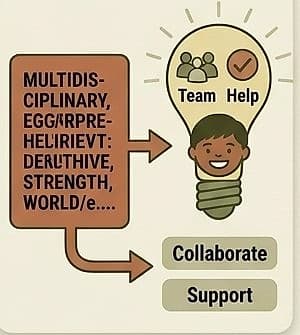
Every clinical field develops its own shorthand -- terms like "sensory regulation," "expressive language delay," "escape-maintained behavior," or "joint attention" are precise and efficient among professionals, but often meaningless or even alarming to caregivers hearing them for the first time.
The skill of explaining difficult concepts simply is not about "dumbing down" information -- it is about translating accurate clinical meaning into everyday language without losing the substance. A useful technique is the "explain it like you're talking to a friend, not writing a report" test: if you find yourself using a term you wouldn't use in casual conversation, pause and translate it. "Expressive language delay" becomes "he understands more than he can say back to you right now." "Escape-maintained behavior" becomes "he's using this behavior to get out of things that feel too hard, so we want to teach him a better way to ask for a break."
Analogies and everyday comparisons are powerful tools here. Comparing developmental progress to a growth chart (some children are naturally on a different part of a normal curve, and what matters is the direction of the curve, not a single point on it) or comparing a skill-building plan to physical therapy after an injury (you have to practice consistently, in small steps, before you see big changes) gives caregivers something intuitive to hold onto.
It also helps to check understanding actively rather than passively. Instead of asking "Does that make sense?" (which most people will answer "yes" to regardless, out of politeness or fatigue), ask caregivers to explain the concept back in their own words, or ask what questions they still have. This surfaces genuine gaps in understanding far more reliably.
Finally, resist the urge to explain everything at once. Caregivers absorb only a limited amount of new information in a single conversation, especially if it's emotionally significant. Prioritize the two or three most important points for today's conversation, and plan to build on them over subsequent conversations rather than front-loading everything into one dense explanation.
Practical takeaway: Before any caregiver conversation, translate your key clinical terms into plain-language equivalents in advance, and plan to check understanding by asking caregivers to reflect concepts back in their own words.
This guide is general information, not a diagnosis or medical advice. If you're worried about your child, the next step is a conversation with a qualified therapist.
Keep reading


More for your practice
Structured courses with completion tracking live in your therapist dashboard.