
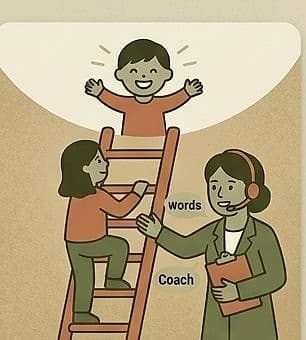
Parent coaching is a specific therapeutic approach in which the therapist's primary role shifts from directly performing all intervention with the child to actively teaching, guiding, and supporting caregivers to carry out strategies themselves, especially within everyday routines. It represents a meaningful shift from a purely therapist-led model toward a family-centered model of care (Medbridge, "How Parent Coaching Enhances Pediatric Occupational Therapy").
This approach is grounded in a simple but powerful insight: a therapist typically sees a child for a small number of hours per week, while caregivers are present for nearly all of a child's waking hours. Strategies that only happen during the therapy session, and never generalize into daily life, produce far more limited progress than strategies a caregiver can naturally weave into routines like mealtimes, bath time, dressing, and play, many times every day. Evidence cited in pediatric occupational therapy literature supports this directly: children whose caregivers had high participation in coaching-based therapy showed significantly greater developmental progress than children whose caregivers had lower involvement.
Effective parent coaching rests on a few core principles: treating caregivers as equal partners in decision-making rather than passive recipients of expert instruction; focusing on practical strategies that fit naturally into the family's actual daily routines rather than requiring a whole new structured activity; actively building caregiver confidence and understanding of why a strategy works, not just what to do, so caregivers can adapt flexibly rather than only following a script; meeting families in their natural environment or context whenever feasible, since strategies practiced and modeled in the actual setting where they'll be used tend to generalize better than strategies only demonstrated in an artificial clinic setting; and adjusting the coaching relationship over time as the child's needs and the family's confidence evolve.
In practice, a coaching-oriented session often looks different from a purely direct-treatment session: rather than the therapist working with the child while the parent observes passively, the therapist might guide the parent through trying a strategy in real time, offer in-the-moment feedback, and problem-solve together when something doesn't go as planned -- building the caregiver's own competence and confidence rather than creating dependence on the therapist's presence to make progress happen.
Practical takeaway: Whenever clinically appropriate, actively involve caregivers in doing the strategy during sessions, not just watching it -- competence is built through guided practice, not observation alone.
Module 4 references: Kids First Services, "Why Regular Communication Between Parents and Therapists is Vital" (kidsfirstservices.com/first-insights/why-regular-communication-between-parents-and-therapists-is-vital); PCS-OK, "7 Essential Steps to Collaborate Effectively with Families in Pediatric Therapy" (pcs-ok.com/7-essential-steps-to-collaborate-effectively-with-families-in-pediatric-therapy/); Child Therapy Guide, "Child Therapist Tips: Building Rapport" (childtherapyguide.com/blog/child-therapist-tips-building-rapport); StatPearls (NCBI Bookshelf), "Psychotherapy and Therapeutic Relationship" (ncbi.nlm.nih.gov/books/NBK608012/); Medbridge, "How Parent Coaching Enhances Pediatric Occupational Therapy" (medbridge.com/blog/how-parent-coaching-enhances-pediatric-occupational-therapy).
This guide is general information, not a diagnosis or medical advice. If you're worried about your child, the next step is a conversation with a qualified therapist.
Keep reading



More for your practice
Structured courses with completion tracking live in your therapist dashboard.